
Are you still paying an annual subscription for patent searching?
The old models are breaking down
For decades, IP work has been shaped by linear end-to-end processes built around static tools and predefined steps. That model is now beginning to break down. Recent advances in AI, when combined with authoritative data, specialized tools, and expert control, are enabling a fundamental shift in how knowledge work is performed. Rather than moving through chunky, sequential workflows dictated by decades old providers, practitioners can now operate within fluid, continuously evolving environments where analysis, validation, and insight development happen simultaneously. The focus moves from executing predefined processes to producing outcomes aligned with real-time objectives. Looking ahead, this shift has profound implications for how IP professionals collaborate with technology, adapt their workflows on the fly, and ultimately redefine the nature of their work in an AI-enabled future.
Can you trust an LLM without the right tools?
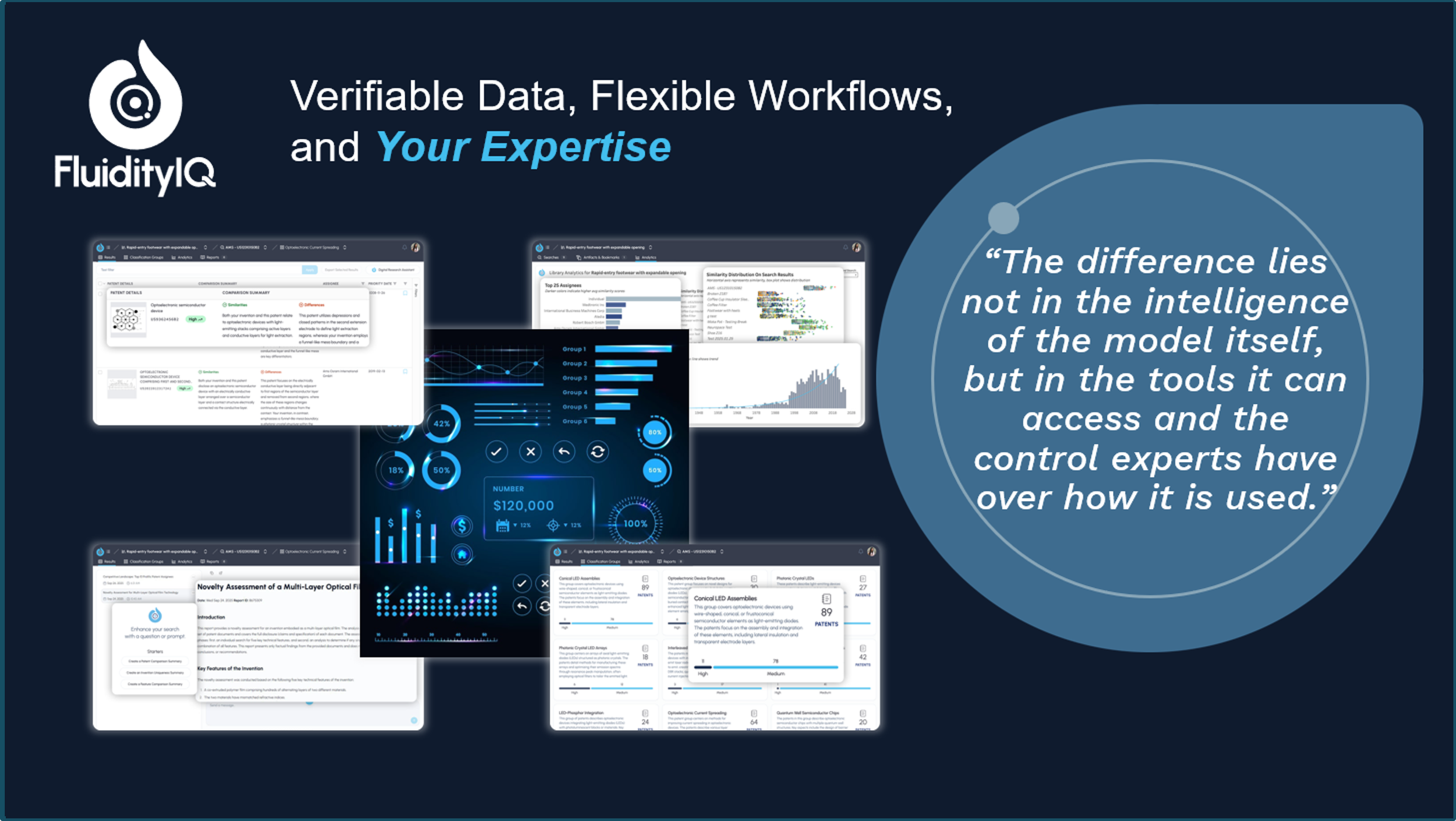
As large language models find their way into high-stakes professional workflows, the challenge is no longer whether they can produce plausible answers, but whether those answers can be trusted. The difference lies not in the intelligence of the model itself, but in the tools it can access and the control experts have over how it is used. A simple calculator analogy helps make this distinction clear.
An off-the-shelf LLM is like a basic desktop calculator. It reliably performs the operations it was designed for, but it can only work with what’s entered directly and what’s built into its circuitry. It has no awareness of external context or specialized data. In the same way, a standalone LLM can summarize and generate language impressively, yet it is ultimately constrained to internal patterns learned during training. Its output may look precise, but it cannot verify results against authoritative, domain-specific sources in real time.
Blending rich context with your own expertise builds confidence
When that same LLM is connected to Model Context Protocol (MCP) tools like FluidityIQ’s semantic patent search tool, it becomes more like a scientific or professional-grade calculator. The underlying engine hasn’t changed, but its functional range expands dramatically. It can now reference structured, up-to-date information, apply domain-specific operations, and surface results that would be impossible through internal reasoning alone. This shift isn’t about “better math” — it’s about access to the right instruments at the moment they’re needed.
The trust advantage becomes even clearer when expert users are brought into the loop. A basic calculator gives a single answer with little context; a scientific calculator allows professionals to choose functions, set parameters, and understand how a result was derived. With FluidityIQ, IP attorneys can leverage their expertise directly — refining inputs, testing assumptions, and steering analysis instead of passively consuming output. The combination of authoritative data and expert control turns AI from a black box into a transparent, collaborative tool.
Delivering more than legacy platforms could ever do…without the annual subscription.
That collaboration is what ultimately drives real confidence. Not confidence based on polished language or apparent precision, but confidence grounded in verifiable data, flexible workflows, and expert-driven reasoning. When LLMs are combined with MCP tools like those offered by FluidityIQ, they don’t just improve traditional patent search — they fundamentally change how it’s done. The result is not another layer on top of legacy systems, but a new way of working that makes static, keyword-driven patent platforms increasingly irrelevant. For practitioners who need answers that stand up to scrutiny, this shift isn’t incremental; it’s decisive.
Discover how FluidityIQ can help your organization develop its own innovation ecosystem based on your in-house expertise, not a vanilla platform. Reach out to us at info@fluidityiq.com or schedule a demo today!