
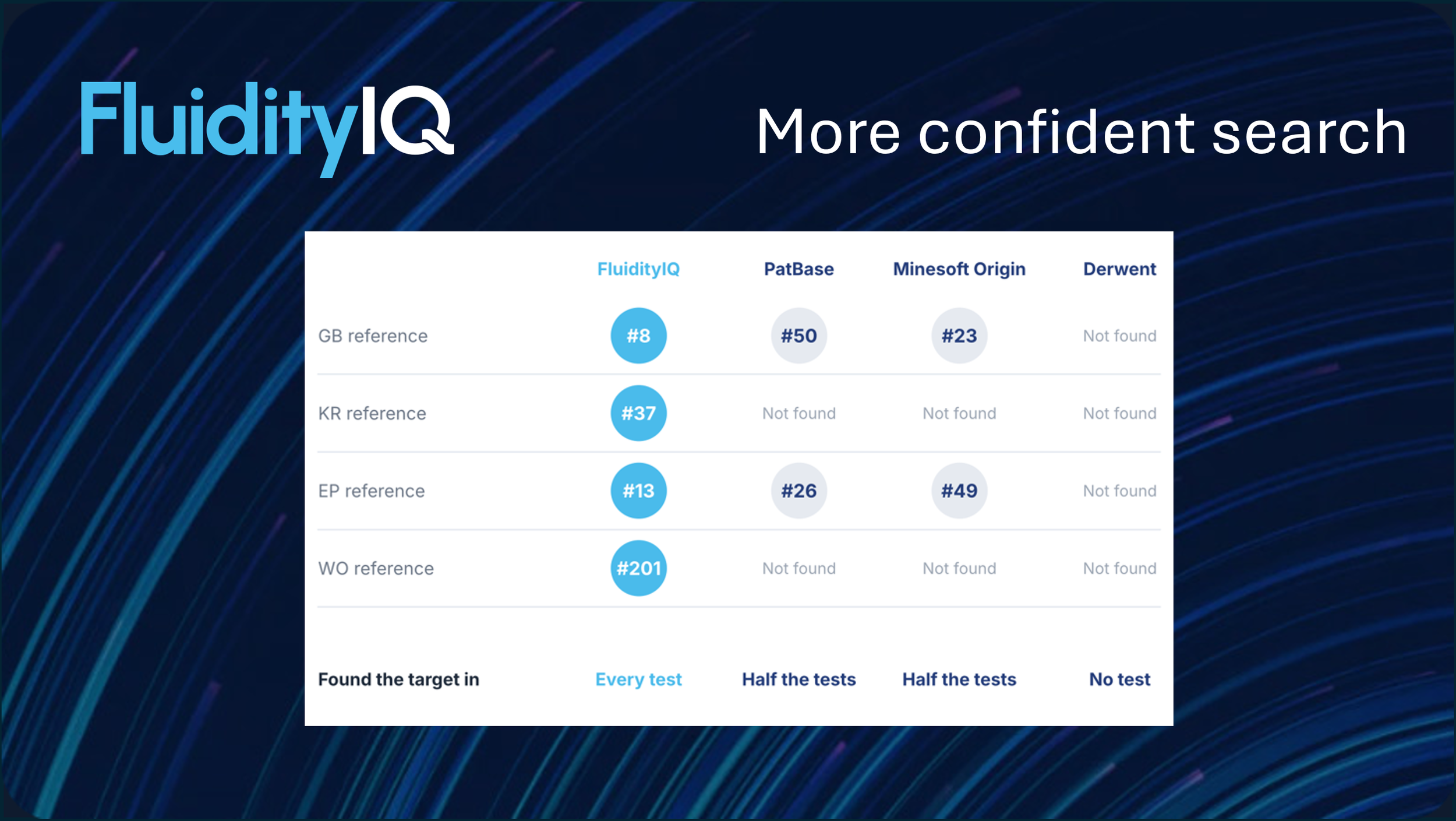
An independent patent agent put four leading platforms to the test, then checked FluidityIQ against PatSnap’s own benchmarks.
The agent designed the study without guidance from FluidityIQ, choosing the test cases, writing the searches and defining how the platforms would be compared. The tests covered a deliberately broad range of technology: electrical and electromechanical devices, polymer and materials chemistry, cosmetic and personal care formulations including probiotic-derived ingredients, and industrial design. The searches varied in style, from detailed, claim-like invention descriptions to brief queries naming just a few components. The target references spanned multiple jurisdictions, including non-English and decades-old art.
Each platform received the same AI semantic search, with no Boolean assistance since Boolean strings would have reflected the agent’s own expertise rather than each platform’s capabilities. The agent recorded whether, and where, each platform returned the known target. The agent also compared each platform’s novelty reports and AI agent capabilities. The agent separately replicated the example cases PatSnap publishes on its own benchmark pages.
The results tell the story
FluidityIQ was the only platform to find the target art in every test, ranked it higher than the alternatives, and delivered it in focused reports a practitioner can actually review.
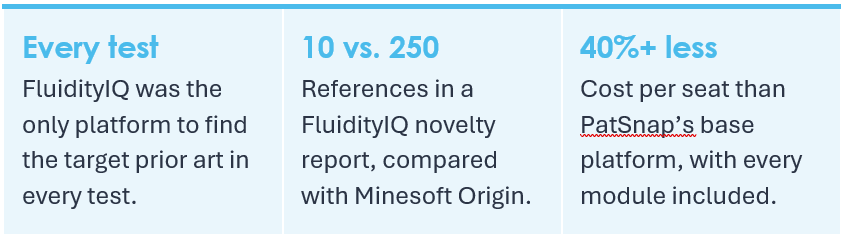
Finds the prior art others miss. FluidityIQ was the only platform to return the target reference in every test. In half the tests, no other platform found it at all.
Puts the right art at the top. When others found the target too, FluidityIQ ranked it about twice as high.
Delivers an answer, not a list. FluidityIQ’s novelty reports held about 10 references and included the target every time. Minesoft Origin’s held 250 and missed one target entirely.
AI that reads the whole patent. FluidityIQ’s agents work across 1,000 references, use the full text and answer any question about any patent.
PatSnap-level results for at least 40% less. FluidityIQ matched PatSnap’s own published examples, with every module, including design search, in one per-seat price.
In half the tests, FluidityIQ was the only platform to find the target at all.
In a novelty search, the costly error is the reference that never appears. FluidityIQ was the only platform that returned the target art in every test, and in half the tests it was the only platform to find it at all.
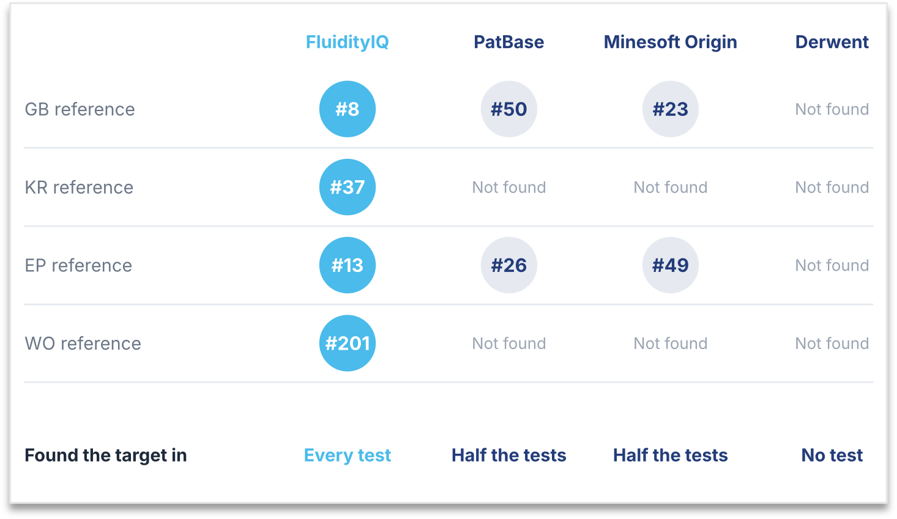
Where other platforms also found the target, FluidityIQ ranked it roughly twice as high, so a practitioner reaches it after reviewing half as many references or fewer. Derwent did not return the target in any test and also missed a key assignee in one of the technology areas searched.
An answer, not a list.
Minesoft Origin delivered 250 references and still missed the target. FluidityIQ delivered 10, with the target included.
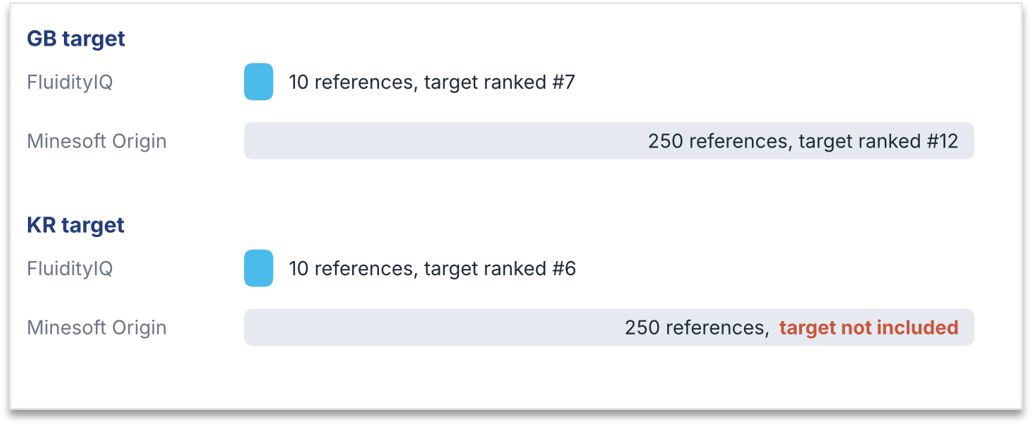
A 250-reference novelty report is closer to a results list than an assessment. It hands the screening back to the practitioner, who still has to read and judge every reference. In the KR test, all 250 references were delivered, and the target art was still missing: showing that more volume does not replace better recall.
The workflow differed too. FluidityIQ confirms or clarifies the request once and then builds the report. Origin asks a series of questions along the way and needs more approvals, splitting the work into one semantic search and several Boolean searches.
AI that reads the whole patent
Every platform in this study promotes AI and semantic search. In practice, FluidityIQ was the only one with AI at every step, from building the search to writing the report. Derwent offered semantic search with no AI agents at all.
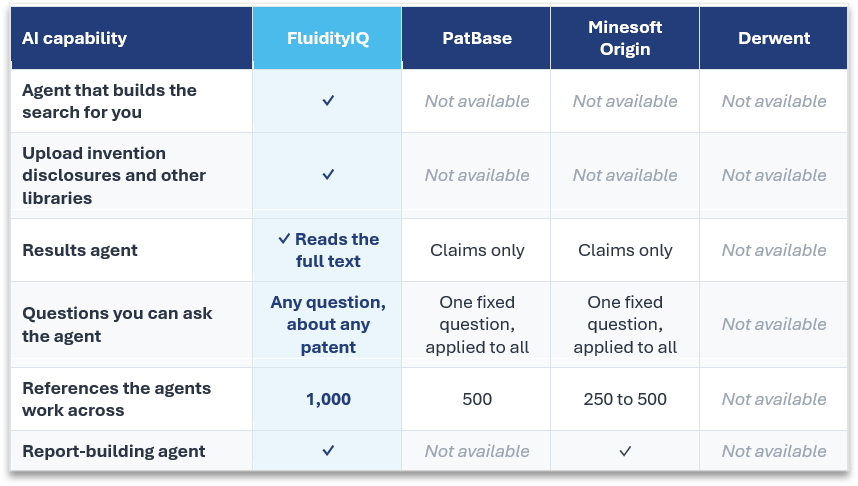
In PatBase and Minesoft Origin, the practitioner sets one summary or yes/no/maybe question, and the agent applies it to every reference, using the claims alone. FluidityIQ works like a conversation with a research colleague: ask about a specific patent, follow up, and draw on the full specification, where much of the disclosure relevant to novelty sits.
Comparing FluidityIQ to PatSnap’s own benchmark
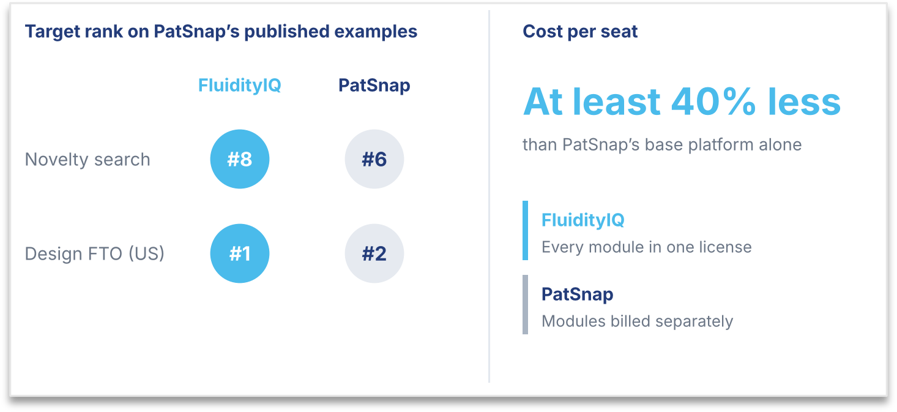
Run in FluidityIQ, PatSnap’s own example cases produced comparable results: the novelty target landed in FluidityIQ’s top ten, and FluidityIQ ranked the design target first, ahead of PatSnap’s published result. FluidityIQ also carried the novelty target into a focused 10-reference report.
The difference is in what you pay and what you get. A FluidityIQ seat costs at least 40% less than PatSnap’s base platform alone, and every module, including design search, novelty reports and the AI agents, comes in one per-seat price. PatSnap bills its modules separately, so the gap widens with every module a team adds.
Image-based design search is built into FluidityIQ at no additional cost, and its results matched the best in the study. PatBase and Derwent offer no image search.
In a US design freedom-to-operate search using PatSnap’s own benchmark case, FluidityIQ ranked the target design patent first, as did Minesoft Origin. PatSnap’s published result ranked it second. Across all jurisdictions, FluidityIQ and Origin both placed the target in their top ten, with FluidityIQ ranking it higher.
Methodology
An independent patent agent compared FluidityIQ with PatBase, Minesoft Origin and Derwent, and checked FluidityIQ against PatSnap’s own published benchmarks.
Search type: AI semantic search only, with no Boolean searching, so each platform’s AI was tested on equal terms.
Consistent inputs: The same search text and date limits were used in every platform, where the platform supported them.
Measurement: Each test targeted a known prior art reference. The agent recorded whether it appeared in each platform’s results and at what rank.
Novelty reports: These were run in each platform’s own report workflow, where one exists.
PatSnap: PatSnap was not available for direct testing. The agent replicated the example cases on PatSnap’s own published novelty and design benchmark pages in FluidityIQ and compared the results with PatSnap’s published results. PatSnap’s headline benchmark rates are aggregates across several hundred cases and were not replicated. PatSnap’s features were not evaluated separately.
Timing: Testing was completed in November 2026. Results reflect each platform as tested at that time.
To learn more about this comparative study or to schedule a live demo, reach out to us at sales@fluidityiq.com. To download the complete study, click here.