
Semantic and Boolean, Together: Why Combined Search Builds a More Complete Picture
Blend semantic and Boolean search for the most complete results
Semantic search and Boolean search each see a patent collection differently. FluidityIQ now runs both side by side from a single starting point, then shows you exactly which method found each patent.
For years, patent searchers have debated which approach is better. Semantic search understands meaning, so it finds relevant documents even when they use different words. Boolean search follows your exact instructions, so it is precise, repeatable, and easy to explain. Each has real strengths, and each has blind spots.
The better question is not which method to use, but how to get the benefits of both without doubling your work. In FluidityIQ, both strategies run simultaneously within one platform, so there is no second application to subscribe to and no result sets to merge by hand. Built-in tools then help you untangle the results and compare them on a common scale. This article explains how combined search works, walks through a real example, and describes why running the two methods together produces a more complete and more trustworthy result set.
How combined search works
Combined search follows five steps, and you stay in control at each one.
1. Start with a semantic search. Describe the invention or technology in plain language, the way you would explain it to a colleague.
2. Get a Boolean string generated for you. FluidityIQ translates your semantic description into a Boolean search string, giving you a structured starting point instead of a blank page.
3. Refine each strategy separately. Edit the semantic text and the Boolean syntax independently. Add synonyms, adjust operators, tighten a concept, or broaden one, until each strategy says exactly what you mean.
4. Choose your blend. Decide how many of the top Boolean results to blend into the semantic results. A tight Boolean string can contribute more; a broad one can contribute fewer, so it does not crowd out stronger matches.
5. Run both and review. FluidityIQ runs both searches at once. Every result is tagged by source: semantic, Boolean, or both. The re-ranker scores the blended set as High, Medium, or Low relevance, you can sort results by search strategy, and the digital research assistant can analyze the results with you.
A worked example: protective coatings for battery cathodes
A patent agent recently used combined search to look for prior art on a lithium-ion battery technology. The example shows what each method contributes and why the combination matters.
The semantic strategy described the invention in plain language:
Application of a conformal aluminum oxide coating of 2-5 nm thickness to single-crystal NMC811 cathode particles using atomic layer deposition. The coating acts as a solid electrolyte interphase that suppresses transition metal dissolution and maintains structural integrity during fast charge/discharge cycles, achieving >95% capacity retention after 500 cycles at 3C rate.
The Boolean strategy expressed the core concepts as a working string. The agent refined it across more than one iteration before settling on this version:

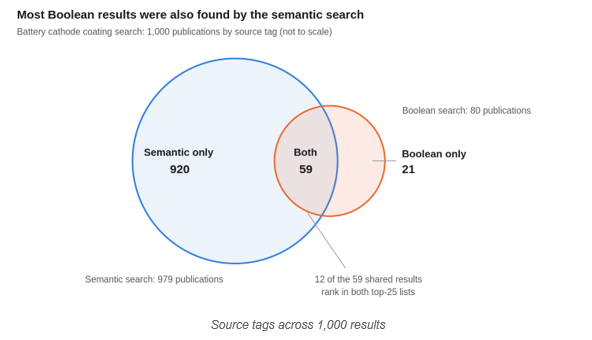
FluidityIQ retrieved 1,000 publications across the two strategies, and the source tags told a clear story. The semantic search found 920 on its own, both searches found 59, and the Boolean search found 21 on its own.
The agent then asked the digital research assistant to compare the two strategies directly:
Compare the top 25 semantic results with the top 25 Boolean results. Tell me which produced the most relevant results and where they produced combined results. Use the re-ranker score to show which produced better results. Build a table to compare the results.
The assistant's analysis highlighted three findings.
The semantic search surfaced the strongest matches. The re-ranker rated its top 25 results as more relevant, overall, than the Boolean top 25. The result it rated most relevant of all, US12027661B2, was found by the semantic search alone.
The overlap marked the core of the result set. Twelve patents appeared in both top-25 lists, and they held the first twelve positions in the Boolean ranking. Where precise keywords and conceptual similarity agreed, the results were consistently strong.
The semantic search widened the field. The Boolean string concentrated on a handful of patent families from a few assignees. The semantic search found those same families, plus relevant art from GEM, Corning, GM, POSCO, and Lawrence Livermore National Security that lacked the exact combination of Boolean terms. The agent saw the same pattern at the level of individual terms: because the Boolean string required NMC811, it returned only documents using that designation, while the semantic search also surfaced related chemistries such as NMC, NMC111, and NMC622.
The agent did not stop at the top 25. Reviewing deeper into the results, the agent judged US12191485B2 the most relevant reference, along with the WO2020251710A2 / US20220158160A1 family. Both searches found these references, but neither ranked them in its top 25. The re-ranker prioritizes your review; your expertise still decides what matters most. Because these references carried the “both” tag, sorting by strategy is a fast way to find high-confidence references that sit lower in the ranking.
In this search, the Boolean-only results added little, and none ranked among the strongest matches. The Boolean string's value was corroboration: a precise, documented query that independently confirmed the core references. The agent's overall view was that both methods were useful and both produced some noise. That is exactly why running them together, with each result clearly labeled, is more valuable than relying on either one alone.
Why combining the two matters
Precision and completeness in one result set
A well-crafted Boolean string is precise. It finds documents that contain the exact terms, chemistries, or claim language you care about. Semantic search adds reach, finding documents that describe the same idea in different words. Running them side by side gives you a result set that is both focused and complete, so you are not trading one strength for the other.
Each search makes the other better
The source tags turn every search into a learning opportunity. Semantic-only results reveal terminology your Boolean string missed, like the NMC variants in the example above, which you can fold back into the working string. Boolean-only results can show where exact terms matter, such as specific compound names or precise claim phrasing. In some searches they add little, as in the example, and you can blend fewer of them. In technologies where a single precise term carries the meaning, they can matter more. Because you can edit each strategy separately, you can close those gaps and run again.
Clarity about why every result is there
Every patent in your results carries a label: semantic, Boolean, or both. You always know how a reference was found, and you can sort by strategy to review each group on its own. Results found by both methods form a natural first tier for review, since two independent approaches agree that they matter.
One relevance scale for blended results
Semantic similarity and Boolean matching do not naturally produce comparable scores. FluidityIQ solves this in two ways. You control how many top Boolean results enter the blend, so a broad string cannot flood the set. The re-ranker then places every result on a single High, Medium, or Low relevance scale, so you can review the whole set consistently.
Efficiency without extra steps
Without combined search, covering both methods means running two searches, often in two tools, then exporting, merging, and reconciling the results by hand. FluidityIQ generates the Boolean string, runs both strategies at once, and returns a single ranked set, with each publication listed once and tagged by source. The time you save goes into analysis instead of data handling.
Defensibility you can document
In freedom-to-operate, invalidity, and patentability work, you often need to show how a search was conducted. A Boolean string is explicit, repeatable, and easy to include in a search report. Pairing it with semantic search gives you the reach of AI along with an audit trail that clients, counsel, and colleagues already understand and trust.
Lower risk of missing what matters
In high-stakes searches, a single missed reference can be costly. Two independent retrieval methods reduce that risk. If one method misses a relevant patent because of unexpected wording or overly narrow syntax, the other has a chance to catch it, as the semantic search did with US12027661B2.
Flexibility for every kind of searcher
Experienced searchers do not have to give up the Boolean techniques they have refined over years. Newer users can start in plain language and receive a well-formed Boolean string they can learn from and adjust. Teams with different skill levels can work in the same tool, each in the way that suits them.
Deeper analysis with the digital research assistant
The digital research assistant works directly within your search results. As the example shows, you can ask it to compare the references found by each strategy, measure where they overlap, or explore what the semantic-only results have in common. Because every result carries its source tag, the analysis can take into account not only what was found, but how it was found.
Getting the most from combined searching
A few practices help you get the most from combined search:
Treat the Boolean string as a working draft. Use the generated string as a starting point, then refine it as the results teach you more about the terminology in the field.
Review the overlap first. Results found by both methods are usually the strongest candidates.
Look beyond the top of the list. Sort by strategy to find references tagged “both” that rank lower; the most relevant reference may not be at the top.
Mine the semantic-only results. They often contain synonyms and variants worth adding to your Boolean string.
Adjust the blend to fit the string. Blend more Boolean results when the string is tight and its results are strong, and fewer when it is broad or its unique results are weak.
Semantic and Boolean search are not competitors. Each answers a different question: one asks what a document means, the other asks what it says. FluidityIQ lets you ask both questions at once, see exactly where the answers agree and differ, and refine your approach until the results fit your needs. The outcome is a search that is more complete, easier to understand, and easier to defend.
Please reach out to support@fluidityiq.com for more assistance on using any of the features of FluidityIQ.