
FluidityIQ adds portfolio analysis: No bolt on module or new contract required
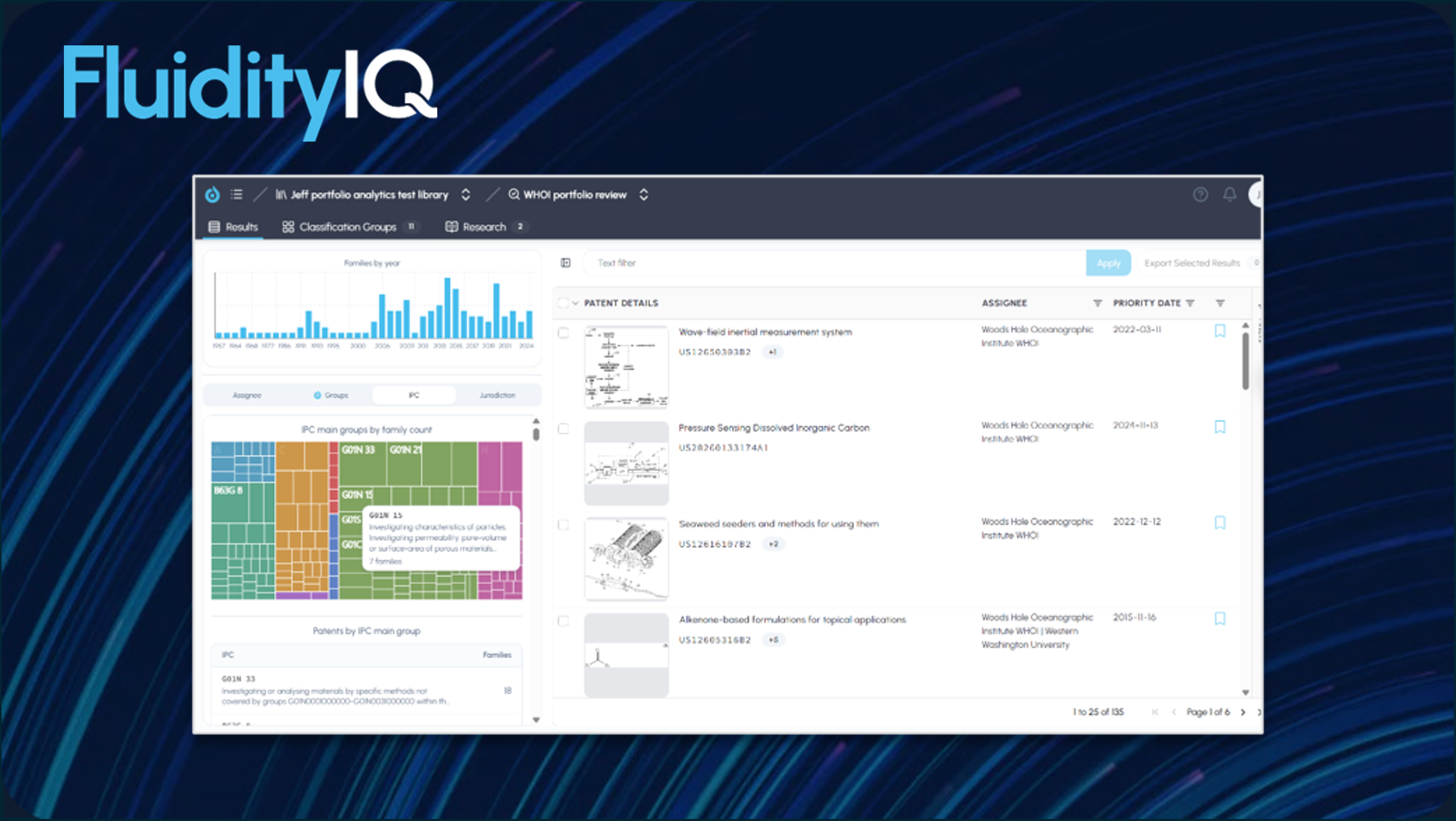
One platform serving search and portfolio analytics
Market leading technology clustering and semantic search now combined with portfolio analytics.
FluidityIQ was built on a single architectural idea: you define a corpus, and everything else works on whatever corpus you've defined. Utility patent search was the first way in. Design searching was the second. Today we're adding the third: portfolio analysis. You run a semantic search to explore an idea; you build a portfolio to analyze company holdings. Now you can do both with one contract.
A third way to build a corpus.
Every FluidityIQ workspace starts by defining a set of patents to reason about. Until now, you defined that set indirectly, by describing an invention or by supplying a design. A portfolio analysis lets you define it directly, the way IP teams actually think about their own or a competitor's holdings. You can key in a list of patent numbers, upload a spreadsheet, or search and select by assignee. What you build is a first-class FluidityIQ workspace, which means the analytics and the agent you already use are waiting for it.
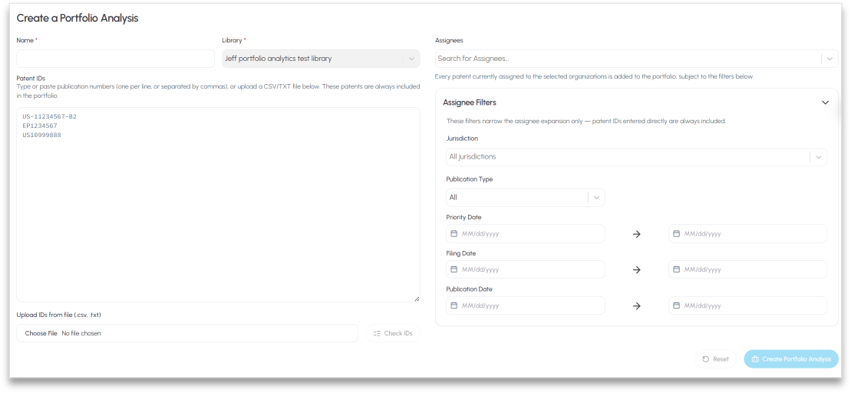
Upload or key enter patent IDs or search by assignee
In this market, portfolio analytics is almost always sold as something separate: a premium module, a different seat, sometimes a different vendor entirely. For FluidityIQ customers, this capability will just show up when you login. It's the same login, the same interface, and the same pay-as-you-go model as everything else. No new seats to provision, no module to license, no separate contract to sign. You build a portfolio when you need one and pay for the portfolios you build, with nothing sitting idle on a subscription line in between.
What we are including in this first release.
We've kept the first release focused on the analysis that answers real portfolio questions:
Build the corpus your way: patent IDs, an uploaded list, or assignee search and selection.
Work from complete records: every asset carries its legal status, and patent family members are exposed just as they are in search results, so you’re reasoning over live, deduplicated holdings rather than a bare list of numbers.
See the shape of ownership: the assignee breakdown and bubble chart show who holds what across the set, which matters the moment you're looking at a competitor or a fragmented space.
Understand the technology, not just the counts: Group Classification, our sub-cluster analysis of the underlying technology areas in a corpus, has been meaningfully upgraded for this release, with more descriptive cluster names, improved grouping and a deeper analysis of technology clusters. Because a portfolio can include design patents, a cluster of ornamental designs surfaces as its own group, an angle most portfolio tools don’t address.
Slice the portfolio and work the subset: a new interactive IPC heat map joins classification, the jurisdiction map, and the assignee bubble chart, and they operate together on one live portfolio. As you filter with any of them, the other visualizations adjust, and so does the portfolio itself: the adjoining panel resolves to the exact subset your interactions define. You're not just looking at a chart of a slice; you can view, access, and work directly with that subset of assets, then keep slicing from there.
Ask the portfolio questions: the Deep Research Agent brings its landscape capabilities to portfolio analysis and adds new ones built for it. It characterizes the portfolio's technology coverage and summarizes where the gaps are, and it stays fully conversational: query it in plain language, push it deeper, or explore uncovered concepts further as your questions evolve. This is a starting point, and the agent's portfolio capabilities will keep expanding.
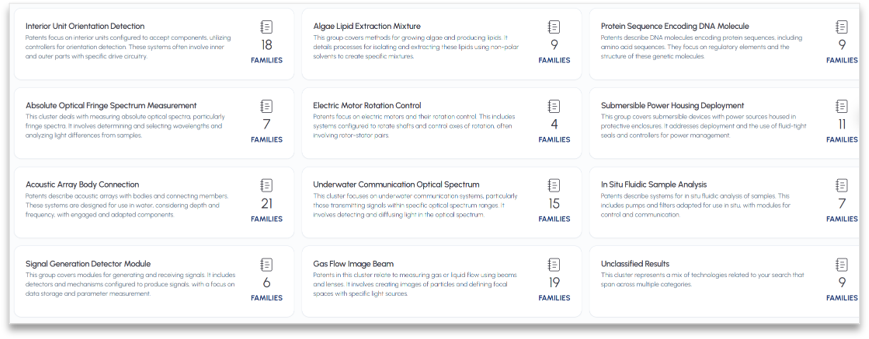
Enhanced technology clustering remove manual effort
Built around the question that actually gets asked.
The through-line of this release is coverage and gaps: the questions a head of IP or an outside advisor gets asked over and over. Where is this estate strong? Where is it thin relative to where the business is heading? How does it sit against a competitor's? The classification, the heat map, and the agent's gap summary are built to get you to those answers, not to a prettier dashboard. Importantly, these capabilities are built to bring this work in-house without adding to your team’s workload. The Deep Research Agent does the analytical work that used to mean commissioning an outside study, so bringing it in-house means replacing or minimizing the engagement, not absorbing the hours. And because you pay only when you build a portfolio, a full portfolio build and analysis runs a small fraction of the cost of a single outside study.
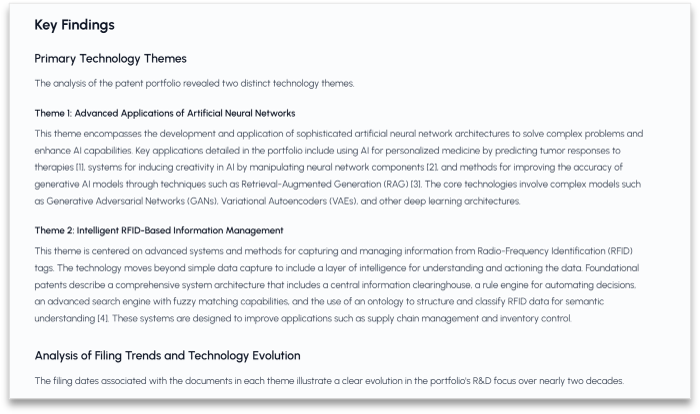
The deep research agent does the heavy lifting
This is the first of a series of releases.
This is a first release, and we're shipping it deliberately, with fundamentals in place, because the next layer is where portfolio analysis on FluidityIQ becomes genuinely exciting. We're using our deep data background to build proprietary data signals that read the underlying strength of a portfolio's technology clusters, adding new dimensions to how assets are assessed and compared. Those signals will layer directly onto the workspaces you're building today, so starting now means the portfolios you create are ready for them the moment they ship.
One login gives you access to everything.
Design, utility, and now portfolio analysis: three ways to build a corpus, one login, one pay-as-you-go model, no seats and no add-on modules. In a market that has trained IP teams to expect a new line item for every capability, we think that's the part that matters most.
Email us at sales@fluidityiq.com or click here to schedule a demo.