
Technology brief: Innovation trends in dexterous robotics
A FluidityIQ technology intelligence brief · July 2026
The hardest problem in humanoid robotics is a hand, and no one has claimed it yet.
For all the attention paid to humanoid robots walking, lifting, and keeping their balance, the field's most stubborn engineering problem sits at the end of the arm. Building a hand that can feel an object, adjust its grip, and manipulate it with anything close to human finesse remains unsolved, and the patent record shows a global field racing at it from every direction at once.
A FluidityIQ analysis of patents filed since 2018 identifies more than 600 patent families devoted to dexterous robotic hands. The most striking feature of that body of work is how unconsolidated it is: no single company accounts for more than a low-single-digit share of it. Dexterous hands are being invented everywhere at once, by very different kinds of players, and "leadership" in the field means two quite different things depending on how you look.
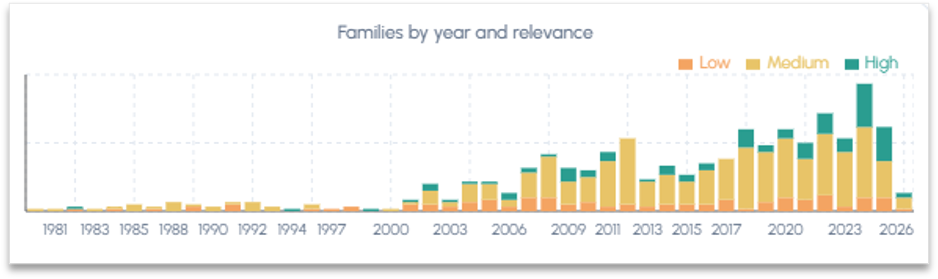
Innovation in the space picked up around 2018
Two kinds of leader.
One kind of leadership is measured by depth and staying power. A handful of established players have treated dexterous manipulation as a long-term commitment rather than a passing bet. Samsung has filed in the area on and off for more than fifteen years and is still filing today; dedicated specialists such as Sarcos in the United States, SoftBank Robotics in Europe, and Shadow Robot in the United Kingdom have built and steadily prosecuted focused hand portfolios across many jurisdictions. Theirs is a leadership of durability: still present, still investing, refining proven architectures while others come and go. The foundations they build on trace back to pioneering work at NASA and in Japanese industrial robotics years ago.
The other kind of leadership is measured by the novelty and momentum of what is being filed now, and here the cast is different. The most distinctive recent inventions come from a fast-moving frontier: Figure AI in the United States, whose filings rank among the most on-point in the entire corpus; a broad and rapidly expanding wave of Chinese companies and research universities, from humanoid makers such as UBTech and dexterous-hand specialists such as Beijing Inspire Robots to university groups like Xi'an Jiaotong pushing the boundary on tactile sensing; and a rising Korean cluster spanning the electronics-components maker LG Innotek and sensor startups such as Aidin Robotics. Individually these players hold only a handful of patents each, but together they are producing a disproportionate share of the field's genuinely new ideas: hands with a palm-facing camera that watches their own fingers make contact, high-density tactile "skin" across the palm and knuckles, and digital-twin systems that turn a human operator's demonstrations into training data.
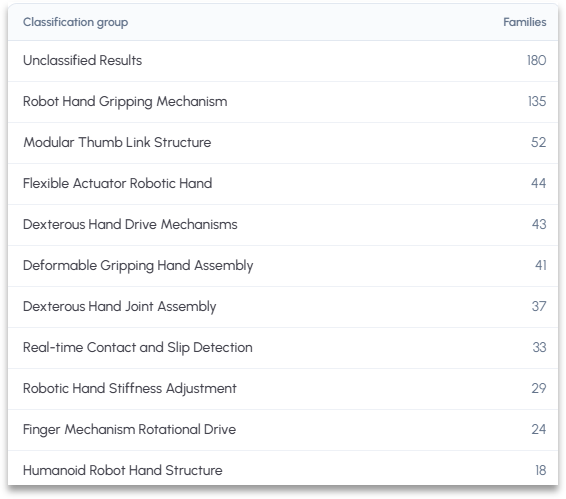
Gripping technology dominates the innovation space
Both are real forms of leadership, and a complete view has to hold them together: rank the field only by how much a company has filed and the frontier's boldest innovators disappear; rank it only by how new and relevant the work is and the durable investors vanish. The geography follows the same split. China now produces the largest and most recent body of on-point work; the United States fields fewer players but several of the highest-impact ones; Korea has emerged as a genuine cluster; Europe holds specialist depth; and Japan, long a foundational force in robotic manipulation, is comparatively quiet at the current dexterous-hand frontier.
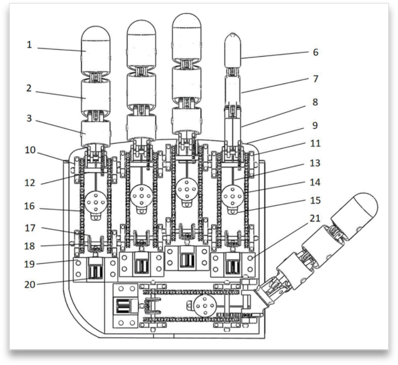
Qingdao University of Technology, Patent CN122034020A
Around both groups sits a third and much larger population that rarely appears on a list of dexterous-hand innovators yet shapes the field all the same: the established industrial-automation and electronics giants (Canon, Omron, Mitsubishi Electric and their peers), whose portfolios in robotic grippers, precision manipulation, and factory automation dwarf the humanoid-hand space proper. They are not leaders in it, and it would be a mistake to count them as such; their manipulation work is built for structured industrial tasks rather than the open-ended, human-like grasping a humanoid demands. But the adjacency is consequential. It is a deep reservoir of actuation, sensing, and manufacturing know-how that any serious humanoid-hand program will have to reckon with: as prior art to design around, as a potential source of components, and as latent competition. Just as important, that same depth makes these incumbents potential partners and backers, not only rivals. The dynamic is not the familiar one of cash-rich giants and cash-poor startups, because capital is not what this frontier lacks: several of its leading names are among the best-funded companies in technology, and some are already public and acquiring suppliers of their own. What the field is short on is consolidation, and that has begun from several directions at once, as well-funded specialists buy up the component layer beneath them and early-stage players take strategic investment from established electronics firms. For the industrial incumbents, rich in manufacturing muscle but comparatively light on frontier IP, that makes partnership, investment, and acquisition the natural way in. They are not in the race today, but few sit closer to the starting line, and the likeliest future is less incumbents versus insurgents than a blurring of the two.
One caveat runs beneath all of this, and it points in a single direction. Patent records look backward by nature: applications usually surface a year or more after they are filed, and the newest work often sits unpublished, or in provisional filings. In a field changing this fast, that lag matters. Some of the most consequential recent entrants are almost certainly already filing yet remain absent from the published record precisely because they are new. The landscape here is a snapshot that, if anything, understates the frontier and the speed at which it is forming, which is why its direction of travel is a firmer guide than any fixed roster of names.
The hardware is outrunning the intelligence.
Read as a whole, the record points to one conclusion above the others: the mechanical problem is closer to solved than the cognitive one. How a hand moves (tendon-driven, direct-drive, or screw-based actuation) is well covered, with no single approach dominant and much of it maturing toward commodity. How a hand decides is not. The high-level control and machine learning that would turn a stream of tactile data into genuinely skilled manipulation is only beginning to appear as claimed invention and remains scarce across more than 600 families. The muscle is being built faster than the mind.
That gap defines where the field is most open. The intelligence layer (the software and learning that convert sensing into skill) is the largest and most defensible white space, and the hardest to engineer around once someone stakes it out. Two further openings sit alongside it: advanced and variable-stiffness materials, largely absent from a record still built on rigid components, and lower-cost designs that trade some dexterity for the price point mass deployment will require.
A look beyond the patent record sharpens the point. The open research literature is already crowded in exactly these areas. Reinforcement and imitation learning for in-hand manipulation, sim-to-real transfer, and systems that learn dexterous skills directly from human video are among the most active topics in academic robotics today, and work on variable-stiffness fingers and low-cost hands built for machine learning is close behind. The ideas that would fill the white space, in other words, are being published faster than they are being patented. That is the essence of the opportunity and its expiry date at the same time: the openings are real now, but the research pipeline feeding them is full, and the most durable positions will go to whoever converts that open science into protected invention first.
The picture, in short, is of a field that has largely worked out how to build a robotic hand and has not yet worked out how to make one intelligent. Leadership is real but divided, held on one side by those who have invested longest and most consistently, and on the other by those inventing fastest. The most valuable territory, the intelligence layer, remains unclaimed by either.
This brief was produced by FluidityIQ from the published patent record, current as of July 2026. Contact sales@fluidityiq.com to learn more about outcome-oriented patent intelligence.
To download the full pdf report click here.