
Design Search shouldn't start with a code
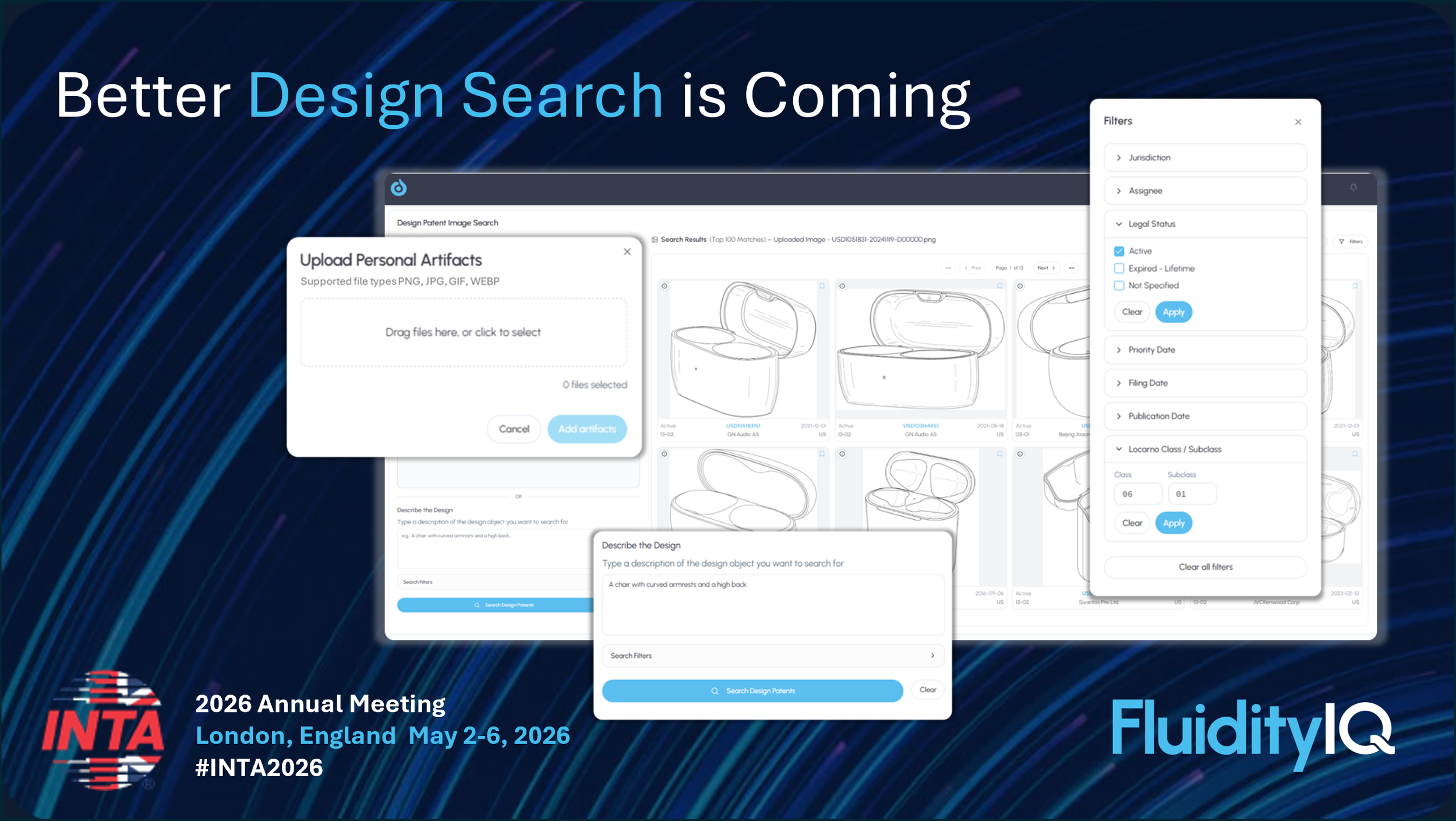
Beta program open through INTA 2026
A limited beta program is open. We're looking for the right practitioners.
The design patent corpus was built by classification. Every filing in it — every registered design that constitutes prior art — was tagged by applicants and their counsel who translated its visual features into a Locarno class and subclass at the time of filing — a translation that can be applied inconsistently across jurisdictions, filers, and time. That classification determined where the design would live in every database built on top of it.
Even as AI image tools have entered the space, most of them suggest or confirm a classification based on what they see in an uploaded image. You're still downstream of that original translation. Your results are still bounded by how well your read of the design matches the examiner's read from years ago.
FluidityIQ Design Search starts somewhere else entirely.
Search the way you think about design.
Upload a photo, a rendering, or a sketch. FluidityIQ returns results ranked by visual and conceptual similarity — across the design patent corpus — without requiring a classification first. Results aren't bounded by how the prior art was tagged when it was filed.
Or describe the design in plain language. If you're working from an early-stage concept or a product brief, describe what you're looking for and the system returns visually similar registered designs. No query construction. No controlled vocabulary. Early clearance work — the kind that shapes product development before it's too late to change course — no longer requires an artifact to get started.
Results that get closer as you work.
As you review results, bookmark the patents most relevant to the features you care about. Each selection steers the search toward that design space without requiring a new query. The results converge. You're not starting over — you're narrowing in.
For practitioners doing complex clearance work, the difference in how it feels is meaningful. For those billing by the hour, the difference in how long it takes matters too.
Search results that stay with you.
For beta partners with access to the integrated platform, design search results connect to a shared intelligence environment where the work persists across matters. Prior art found today becomes part of a body of knowledge that informs the next search. Design and utility patent searches live in the same place, supporting practitioners working across clearance, FTO, and portfolio strategy. Teams can collaborate within the same organized set of references rather than reconstructing context across separate tools.
Standalone tools — including the free options from the EUIPO and EPO — don't offer this. Search and analysis have historically been separate steps. They don't have to be.
A limited beta program — now open.
FluidityIQ Design Search launches at INTA London this May. We are accepting a limited number of beta partners ahead of that launch.
Beta partners receive free access to the platform for the beta period — including the integrated environment described above — and a direct line to the FluidityIQ team to shape what comes next.
We're looking for practitioners for whom design clearance is a regular part of their practice, not an occasional one. Seats are limited, and we'll be filling them before INTA.
Discover how you can participate in the FluidityIQ Design Search beta program. Seat are limited. Reach out to us at info@fluidityiq.com or click here to learn more.