
Patent watch: what FluidityIQ does differently
Changing the economics of patent surveillance.
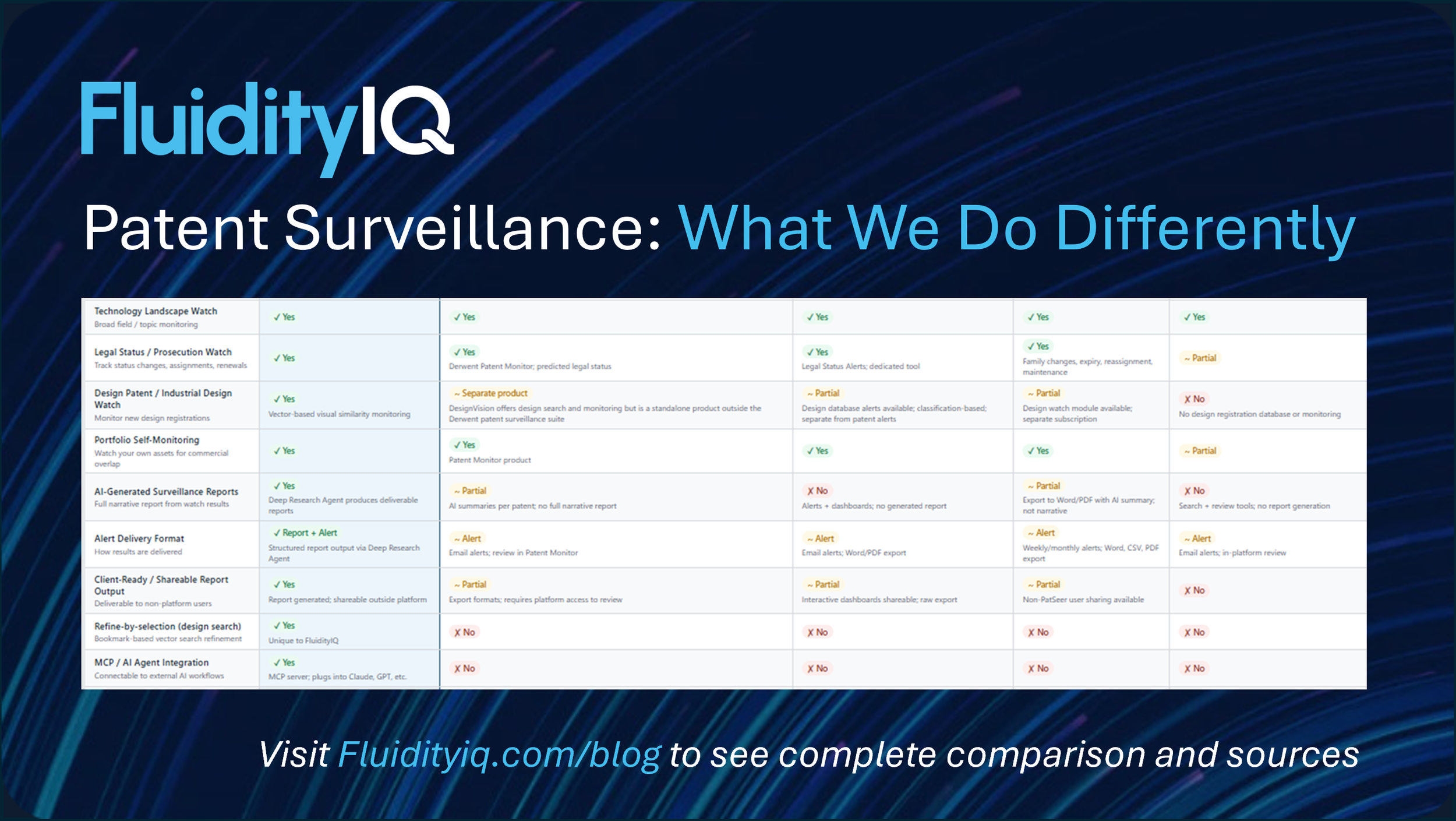
Patent surveillance is a core IP discipline. You know the mechanics — assignee watches, technology watches, legal status monitoring, prosecution tracking. What you may not have seen is a platform that closes the gaps that have persisted across the market. This post covers what FluidityIQ does in patent surveillance that no other platform currently offers and provides a complementary comparison grid at the end of this post.
One watch program. Patents and designs.
The most consistent structural gap in patent surveillance is the separation of patent and industrial design monitoring into disconnected tools, databases, and workflows. Leading platforms treat these as separate problems: patent alerts in one environment, design alerts (if they are available at all) in another, with no shared library and no unified view of the landscape.
FluidityIQ enables you to blend patent and industrial design surveillance in a single environment. Searches, bookmarks, and results across both types live in the same shared library, reviewed together rather than reconciled across separate tools — including coverage of CNIPA, the largest single source of industrial design filings globally and one of the most consistently underrepresented in Western surveillance programs.
Surveillance that produces reports, not just results.
Every alert-based surveillance platform on the market terminates at a list. Per-record AI summaries and threat scoring are improvements to the review experience, but they still leave the synthesis step to the user. Converting a list of relevant patents into an actionable picture of the competitive landscape has always required analyst time, internal effort, or a separate engagement with an IP research firm. That synthesis step is where most of the cost in a patent watch program resides.
FluidityIQ's Deep Research Agent eliminates it. Rather than producing a feed of results for a human to interpret, the Agent generates a structured report directly from watch results — covering technology trends, competitor filing patterns, whitespace and thematic analysis, and threat prioritization. The output is a finished document: ready for a client meeting, an IP committee, or a business unit without additional drafting time.
The practical implications go beyond time savings. Because the synthesis step no longer requires dedicated analyst hours, the economics of portfolio surveillance change. A team that previously had the capacity to actively monitor a fraction of its portfolio — prioritizing only the highest-value assets due to resource constraints — can now run watch programs across a significantly larger portion of the portfolio at the same cost, simply by organizing coverage across multiple libraries. Assets that previously sat unmonitored because the review overhead was too high become active surveillance targets. For large portfolios, that expanded coverage is often where the most valuable licensing opportunities and infringement signals have been quietly accumulating.
For law firms and IP service providers, the commercial model shifts as well. A FluidityIQ-powered watch program can include a report deliverable as a standard component of the engagement rather than as a billed add-on requiring analyst hours — making the service more competitive to offer and more scalable to grow.
Visual search for design surveillance.
The dominant approach to industrial design surveillance is classification-based — searches organized around Locarno codes, which group products by category. This works when competitors file in the same category. It fails when a visually similar design is filed under a different classification, which happens routinely when copying crosses product category lines.
FluidityIQ's design search is vector-based. Rather than filtering by code, it compares visual representations directly — finding images that look like your reference regardless of how the applicant classified the filing. This is how design infringement actually occurs: visually, not categorically.
Two additional capabilities make design surveillance more precise over time. Natural language "Emphasis" filtering allows specific visual elements — a surface treatment, a silhouette, a UI pattern — to be weighted in plain language rather than encoded in Boolean strings or classification codes. And refine-by-selection allows designs identified during review as highly relevant to be bookmarked and used as vectors to refine subsequent searches, recalibrating the watch around what actually matters without rebuilding the underlying strategy from scratch. Both capabilities are specific to design search, where visual nuance and relevance drift are the dominant operational challenges.
MCP integration: patent intelligence inside your AI workflows
FluidityIQ is available via Model Context Protocol (MCP), enabling direct connections to AI assistants including CoPilot, OpenAI and Claude. Patent surveillance queries, landscape searches, and research synthesis execute inside the AI environments where analysis is already happening — without context-switching to a separate platform or re-authenticating between tools.
For IP teams integrating AI into prosecution support, prior art workflows, or competitive monitoring, FluidityIQ functions as a live, structured patent intelligence data layer connected to the AI assistant. No competing surveillance platform currently offers MCP connectivity.
What this means for a surveillance program.
The table below summarizes how FluidityIQ's surveillance capabilities compare to what the market currently offers. See the pdf associated with this blog to see a more complete feature comparison.

Contact us at info@fluidityiq.com to discuss how a patent surveillance program built with FluidityIQ compares to your current workflow. To see the complete feature comparison chart, click here.
Sources
Clarivate / Derwent Patent Search product documentation: https://clarivate.com/intellectual-property/patent-intelligence/derwent-innovation/; Derwent Patent Monitor product page: https://clarivate.com/intellectual-property/derwent/patent-monitor/; Derwent Innovation WIPO Inspire profile: https://inspire.wipo.int/derwent-innovation; Clarivate DesignVision product page: https://clarivate.com/intellectual-property/brand-ip-solutions/design-vision/; Clarivate TrademarkVision acquisition announcement (October 2018): https://clarivate.com/news/clarivate-analytics-to-enhance-ai-driven-trademark-research-solutions-with-trademarkvision-acquisition/
Questel Orbit Intelligence WIPO Inspire product profile: https://inspire.wipo.int/orbit-intelligence; Orbit Intelligence alert settings documentation: https://intelligence.help.questel.com/en/support/solutions/articles/77000436716-setting-up-alerts
PatSeer WIPO Inspire product profile: https://inspire.wipo.int/patseer; PatSeer Capterra profile: https://www.capterra.com/p/190006/PatSeer/; PatSeer pricing editions (G2): https://www.g2.com/products/patseer/pricing
IPRally product features page: https://www.iprally.com/product/features; IPRally Image Search launch blog post (October 2024): https://www.iprally.com/news/introducing-image-search; IPRally patent search page: https://www.iprally.com/patent-search
Derwent Patent Monitor product page: https://clarivate.com/intellectual-property/derwent/patent-monitor/